An early Christmas present from my roofers.
I know just where it came from. I used to see them flying in and out from under the eaves on the back overhang. No way to get in there without pulling off the roof and it didn't go into the attic so I just let it go.
Showing posts with label homeownership. Show all posts
Tuesday, August 30, 2011
Saturday, August 13, 2011
Home Repair and Restoration
As some of you may know, I have an antique house. Not the legal definition that says that a car is antique if it is more than thirty years old, but a real antique house. Built in 1909 by John Cain. I love it. No closets to speak of (except for the ones tucked in under the eaves which you have to be a Yoga expert to get in and out of), hardly any storage space for anything, but it is a cool old house.
So, what do you do if you have an antique house? Why you restore it, of course. For example, you might decide that the front hall would look better if all the beautiful antique wooden trim wasn't covered in layers of white paint. Wait, turns out that "layers" means about thirty, all of them soaked into the antique woodwork. You try heat guns, sixteen kinds of chemical stripper, hours ofbackbreaking really boring labor, and at the end of it all, you have stripped about two thirds of the woodwork and it all looks like crap. Paint won't come out of the little crevices, curved surfaces in the trim now have little splinters sticking out where your scraping tools dug in to the 100 year old wood, and the grain of the wood still has a whitish paint residue (although apparently I can cover that with a gel type stain when the day finally arrives). Now I am really bored with stripping wood and I still have a long way to go. That project gets "postponed".
Wow. That is ugly linoleum in the front porch. It is pulling up and looks non-antique. I think I'll tear it out. Hey, look. When you install linoleum you first glue down plywood to create a nice flat base for the linoleum. Well, the plywood is uglier than the linoleum so out it comes. Check it out. A giant hole into the crawl space under the house. Well, a piece of the plywood cut to size and then hidden by a strategically placed loveseat should do the trick. Maybe I'll ask my neighbor, who is a contractor, for a bid to replace the whole floor in the front porch with nice new wood or something. That was last year. I guess he is really busy.
Hmm. That old carpet looks like garbage. I wonder what is underneath it. Torn up, stained, scratched fir. I guess it could be sanded. Read all about it on the interweb and it turns out that sanding floors is actually not that easy and amateurs routinely ruin perfectly good floors. Well, I guess it could wait until I have money to hire a professional. But wait, that other carpet also looks like garbage (and is really gross due to a particular roommate). I think I'll tear it out. Hmmm. Read sentence four above in this paragraph.
Sensing a pattern? I am super good at tearing out old crappy stuff. Not so great at redoing the stuff I expose with my tearing out. Maybe I should buy a new house with new everything. Wouldn't have the character but I wouldn't currently be sitting here typing in order to avoid having to actually restore something since apparently that isn't one of my strengths. Oh well. Soon it will be winter and I will only be home when it's dark. None of this will show quite as much once that happens and I won't have to worry about it until next summer.
So, what do you do if you have an antique house? Why you restore it, of course. For example, you might decide that the front hall would look better if all the beautiful antique wooden trim wasn't covered in layers of white paint. Wait, turns out that "layers" means about thirty, all of them soaked into the antique woodwork. You try heat guns, sixteen kinds of chemical stripper, hours of
Wow. That is ugly linoleum in the front porch. It is pulling up and looks non-antique. I think I'll tear it out. Hey, look. When you install linoleum you first glue down plywood to create a nice flat base for the linoleum. Well, the plywood is uglier than the linoleum so out it comes. Check it out. A giant hole into the crawl space under the house. Well, a piece of the plywood cut to size and then hidden by a strategically placed loveseat should do the trick. Maybe I'll ask my neighbor, who is a contractor, for a bid to replace the whole floor in the front porch with nice new wood or something. That was last year. I guess he is really busy.
Hmm. That old carpet looks like garbage. I wonder what is underneath it. Torn up, stained, scratched fir. I guess it could be sanded. Read all about it on the interweb and it turns out that sanding floors is actually not that easy and amateurs routinely ruin perfectly good floors. Well, I guess it could wait until I have money to hire a professional. But wait, that other carpet also looks like garbage (and is really gross due to a particular roommate). I think I'll tear it out. Hmmm. Read sentence four above in this paragraph.
Sensing a pattern? I am super good at tearing out old crappy stuff. Not so great at redoing the stuff I expose with my tearing out. Maybe I should buy a new house with new everything. Wouldn't have the character but I wouldn't currently be sitting here typing in order to avoid having to actually restore something since apparently that isn't one of my strengths. Oh well. Soon it will be winter and I will only be home when it's dark. None of this will show quite as much once that happens and I won't have to worry about it until next summer.
Friday, August 12, 2011
100 Years of Roofing Technology: A Primer
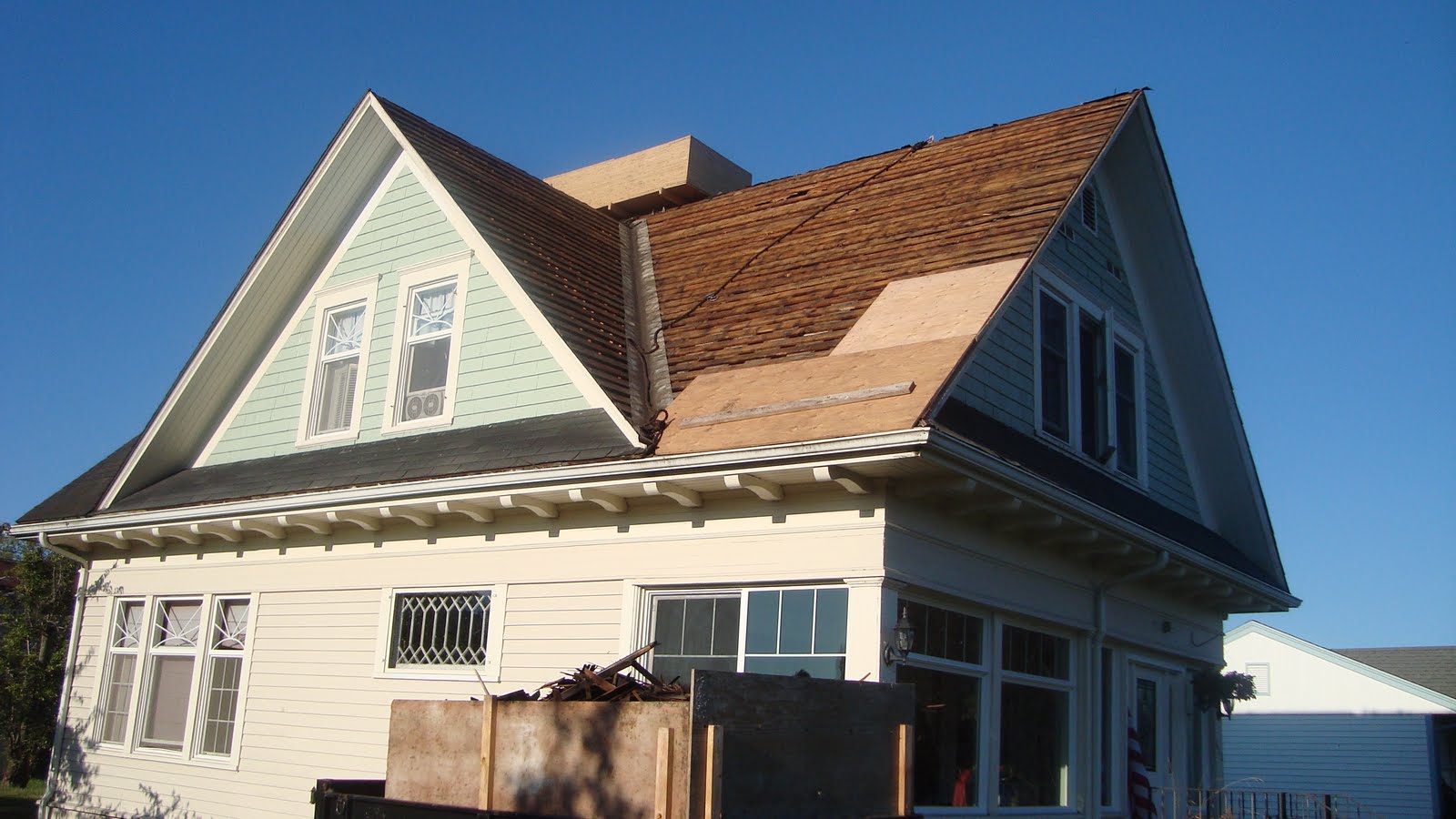
So I'm having my roof replaced. The current roof loses large swathes of itself every winter when the winds come howling up the Fraser Valley and Blaine is right smack in the way. Fortunately, there is more roof underneath each missing swath so it hasn't really been an issue, but at some point, you just have to bite the bullet.
Well, turns out to be an $18,000 bullet. No, that isn't a typo. The forthcoming pictures will show my house to have a ridiculously steep roof. The one time I climbed on it I thought I was going to die, and I'm not even the slightest bit scared of heights. (If you knew me when I was younger, stop laughing. I grew out of it.)
As a related aside, anyone know how many layers of roofing you are legally allowed to put on your roof before you have to tear it down and start over? Yes, the correct answer is three.
Another related aside. How many roofs (rooves or is that just a Tolkienism) might a house that was built 102 years ago have. Let's see. Figure 20 years per roof, 102/20 is a little over five so we'll go with five.
Hah, hah. Wrong answer. I have six. Six complete rooves. Including what are probably (using the math from above) the original cedar shakes. My contractor told me that he had pulled twenty different colored composite shingles from the roof which means that not only were there six complete rooves, they had been patched with different colored shingles (or one of the rooves was made up of a variety of colors. I just thought of that).
So theoretically, to relate this post back to its title, I could analyze each layer of roofing, assuming a twenty or so year spread between layers, and I could tell something about the civilization that developed that composite shingle. Or I could go to Wikipedia.
Addendum: Turns out (according to the interweb) that cedar shakes can last thirty to forty years if properly installed and maintained. I was thinking when I read the first part that I should quickly call and see if I can switch to cedar shakes, then I read the second part and there is no way I am going up on that roof, ever, to do any maintenance. Whatever that consists of. That also throws my math way off, because that means that each of those composite shingle rooves only lasted, on average, twelve years. That doesn't bode well. I'd better move as soon as I finish the roof.
Subscribe to:
Posts (Atom)